
What each system actually does
A tank water heater stores and continuously reheats a set volume of hot water — typically 40 to 50 gallons in a home. It is simple, familiar, and cheaper to install, especially as a like-for-like replacement.
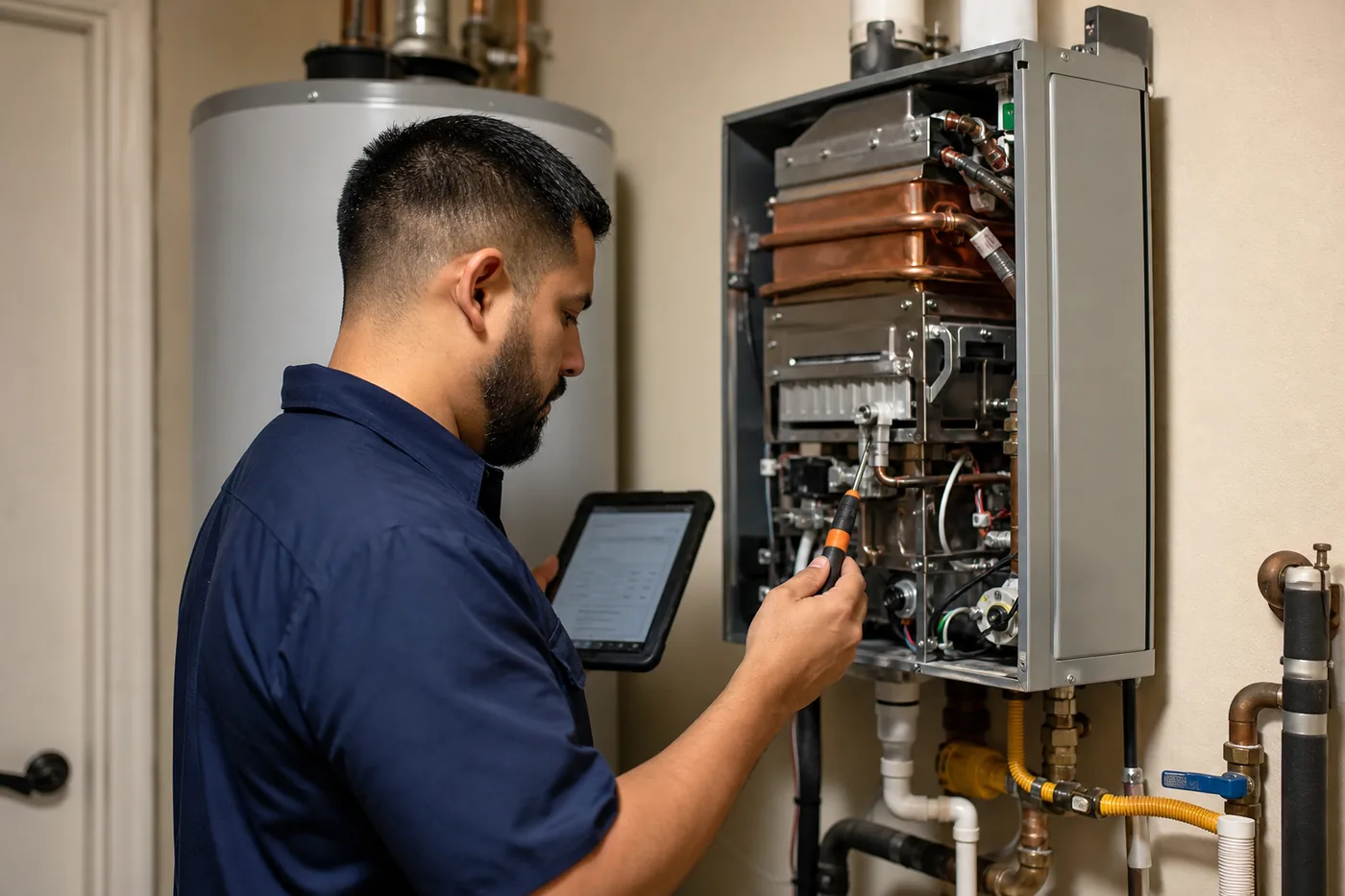
A tankless (on-demand) unit heats water as it flows, so it does not run out the way a tank does — as long as demand stays within its rated flow and temperature rise. That rating matters: a tankless unit cannot exceed the output it was sized for, which is why sizing is the whole game.
The West Texas hard-water factor
Both systems are affected by the Permian Basin's mineral load, but differently. A tank collects sediment on the bottom; a tankless unit builds scale inside a narrow heat exchanger, where it does more relative damage to flow and efficiency.
That means a tankless unit in Odessa needs descaling on the manufacturer's schedule to reach its longer rated life. Skip it, and the efficiency and lifespan advantage erodes — and some manufacturers tie warranty coverage to documented maintenance. Tankless can absolutely be the right call here; it just is not maintenance-free.
The cost comparison that matters
A tank replacement is usually the more predictable, lower-cost job when capacity, fuel, and location stay the same. A tank-to-tankless conversion often adds work: a larger gas line or upgraded electrical, new venting and condensate handling, and relocation. Those items — not the appliance price — drive the gap.
Over a full ownership period, the operating efficiency and longer life of tankless can offset some of that upfront cost, but the payback depends on fuel type, usage, and maintenance. The honest answer is that it varies by home, which is why a real evaluation beats a rule of thumb.
Which one fits your home
Tankless tends to fit households that run out of hot water, want to free up space, and will keep up with descaling. A tank tends to fit homeowners who want the lowest upfront cost and a simple, proven replacement.
Either way, the deciding step is sizing to your actual simultaneous demand and confirming what the installation requires. Our tankless installation page covers what a conversion involves, and our replacement page covers a straightforward tank swap.
Sources and further reading
- ENERGY STAR: how whole-home gas tankless water heaters work
- U.S. Department of Energy: transitioning to a tankless water heater
Equipment-specific instructions and warranty requirements vary by model. Use the manufacturer manual for the installed unit.