
The honest lifespan number
Manufacturers rate a standard storage tank water heater for about 8 to 12 years, and a tankless unit for roughly 15 to 20. Those figures assume reasonably average water chemistry and routine maintenance. Neither assumption holds automatically in Odessa.
In practice, a tank heater that never gets flushed and runs on untreated Permian Basin water can reach the low end of that range — or below it — while the same model with an annual flush and a maintained anode rod can push toward the high end.
Why hard water changes the math in Odessa
West Texas groundwater moves through limestone and dolomite, dissolving calcium and magnesium along the way. That mineral load is what makes the water 'hard,' and it is why the Permian Basin ranks among the harder water regions in the country.
Inside a water heater, those minerals drop out as sediment on a tank bottom or as scale on a tankless heat exchanger. Sediment insulates the burner or lower element, forcing it to run hotter and longer, which stresses the tank and wastes energy. Scale narrows tankless passages and cuts both flow and heat transfer. Over years, that added stress is what pulls real-world lifespan below the sticker rating.
The parts that decide how long yours lasts
The anode rod is the sacrificial metal that corrodes so the steel tank does not. In hard water it can be consumed faster, and once it is gone the tank body starts to corrode — the failure that usually ends a tank's life. Checking and replacing the anode is the cheapest way to add years.
Sediment volume, operating temperature, and how often the unit is flushed all feed into the outcome. A tank that has never been flushed and shows heavy sediment is on a different trajectory than one that has been maintained — which is exactly why a diagnosis matters before you assume a noisy or underperforming heater is finished.
How to get the rated life back
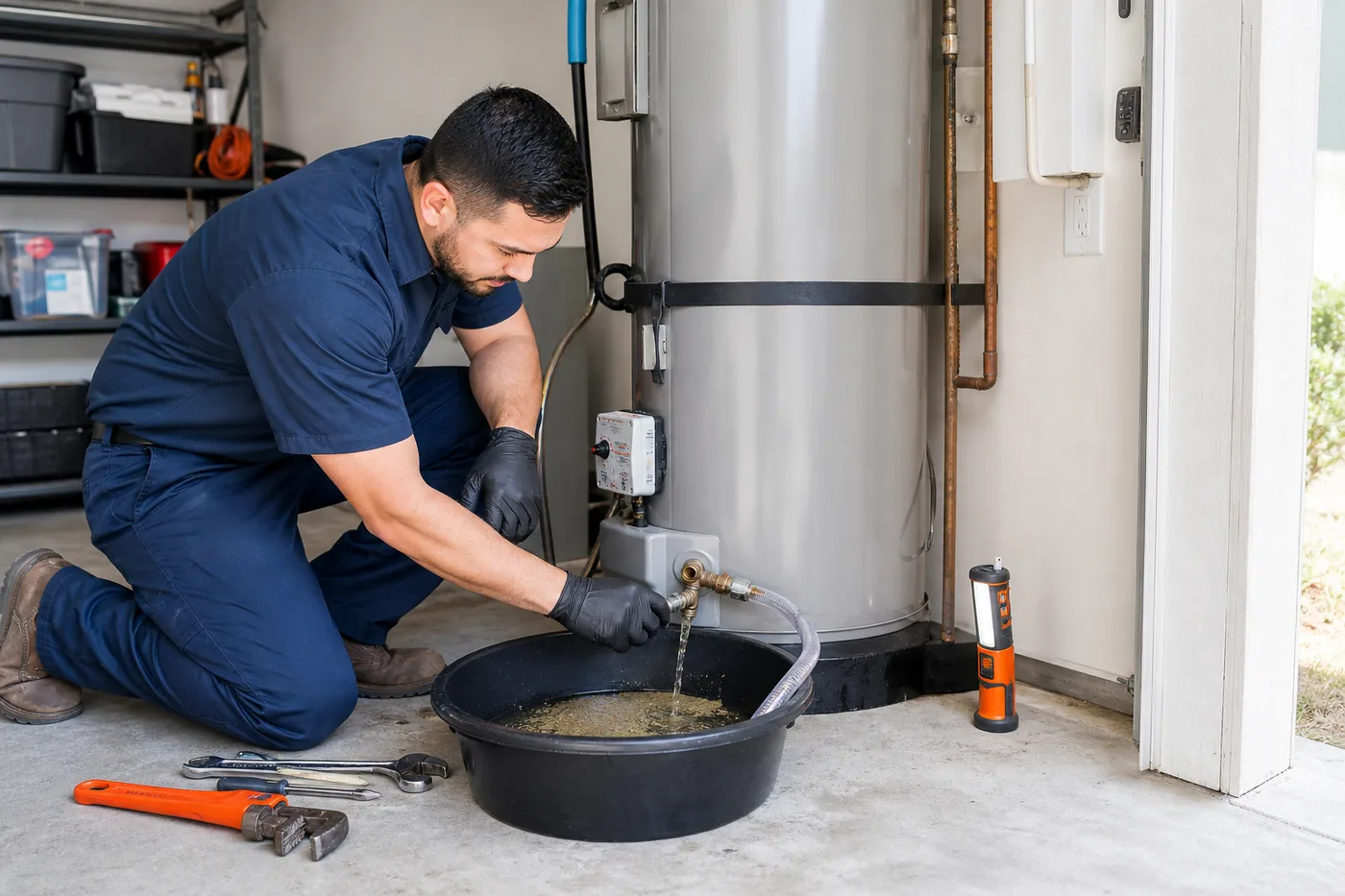
For tank units, an annual flush to clear sediment and a periodic anode check are the two highest-value maintenance items in a hard-water area. For tankless units, descaling on the manufacturer's schedule keeps the heat exchanger clear and protects the warranty.
If your heater is already past eight years, making noise, or losing capacity, the right move is a diagnosis rather than a guess — some of those units have serviceable problems and years left, and some are genuinely near the end. Our repair-or-replace guide walks through how to compare the two honestly.
Sources and further reading
- Rheem: water-heater flushing and hard-water maintenance
- U.S. Department of Energy: tank and tankless service-life considerations
Equipment-specific instructions and warranty requirements vary by model. Use the manufacturer manual for the installed unit.